


Audio Compression Explained
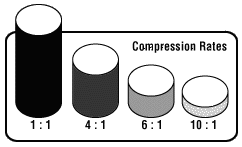
Audio compression shrinks music file sizes so they take up less hard drive space and load faster over the Internet. There are two main types of audio compression: Lossless and Lossy.
Lossless Compression (100% Original Quality)
Lossless compression works like a ZIP file for audio. It shrinks the file size down to about half (a 2:1 ratio) without throwing away any music data. When played back, the sound is identical to the original CD recording.
Lossy Compression (Smaller Files, Reduced Detail)
Lossy compression makes files much smaller (from 4:1 up to 12:1 or more) by permanently removing sound details that human ears notice less. Higher compression creates tiny file sizes, but sound quality drops as more details are removed.
What is a Codec?
A codec (short for coder/decoder) is the software that compresses and plays back music files. Encoding (saving a song) requires extra computer processing power, while decoding (playing a song back) must happen smoothly in real-time without stutters.
Common Audio Compression Formats
ADPCM (Adaptive Delta Pulse Code Modulation)
An older compression method built directly into Windows. It shrinks files down to a 4:1 ratio with very low processing power required, making it fast and easy for computers to decode.
MP3 (MPEG-1 Layer 3)
The most famous lossy audio format in history. MP3 uses perceptual listening models to trim sound data. At 128 kbps bitrate, file sizes are about 10% of the original CD size. For best audio quality on PC or DJ setups, bitrates of 160 kbps mono or 320 kbps stereo are recommended.
MP3 VBR (Variable Bit Rate)
Instead of compressing the whole song at one fixed bitrate (CBR), VBR automatically uses higher bitrates during complex passages and lower bitrates during quiet moments. This balances top audio quality with smaller file sizes.
M4A / AAC (Advanced Audio Coding)
The modern lossy format popularized by Apple, iTunes, and digital streaming platforms. AAC offers better sound clarity and detail than MP3 at the same file size, making it a popular standard for mobile devices and online music.
FLAC (Free Lossless Audio Codec)
The gold standard for high-fidelity lossless audio. FLAC reduces file sizes by roughly 50% without losing a single drop of audio quality. Because it is completely open source and free, FLAC is widely used by audiophiles, DJs, and music archives.
OGG Vorbis
An open-source, patent-free lossy audio format used extensively in video games and streaming services like Spotify. OGG Vorbis provides cleaner sound and better audio detail than MP3 at similar bitrates.